
This summer, we commissioned eight creatives and writers living and practising in the city to research and document a story of creative and cultural innovation in their local community that mattered to them, using a solutions journalism approach. From a mahjong club in Hackney and a zero waste makers cooperative in a disused car park in Brixton to a creative hub in Fish Island and a film hub for emerging talent in Walthamstow, these stories showcase the importance of third spaces – informal networks and places and spaces of creativity and enjoyment – where people from all backgrounds can come together to connect, collaborate and create.
In our first instalment writer, actor and poet Christy Ku explores the uplifting story from the Hackney Chinese Community Services (HCCS), where a weekly game of mahjong has brought together a diverse community, providing a safe space for socialising and building friendships.
A Mahjong Renaissance in Hackney
Words and pictures: Christy Ku (she/they)
http://christyku.co.uk/
@kukadoodles
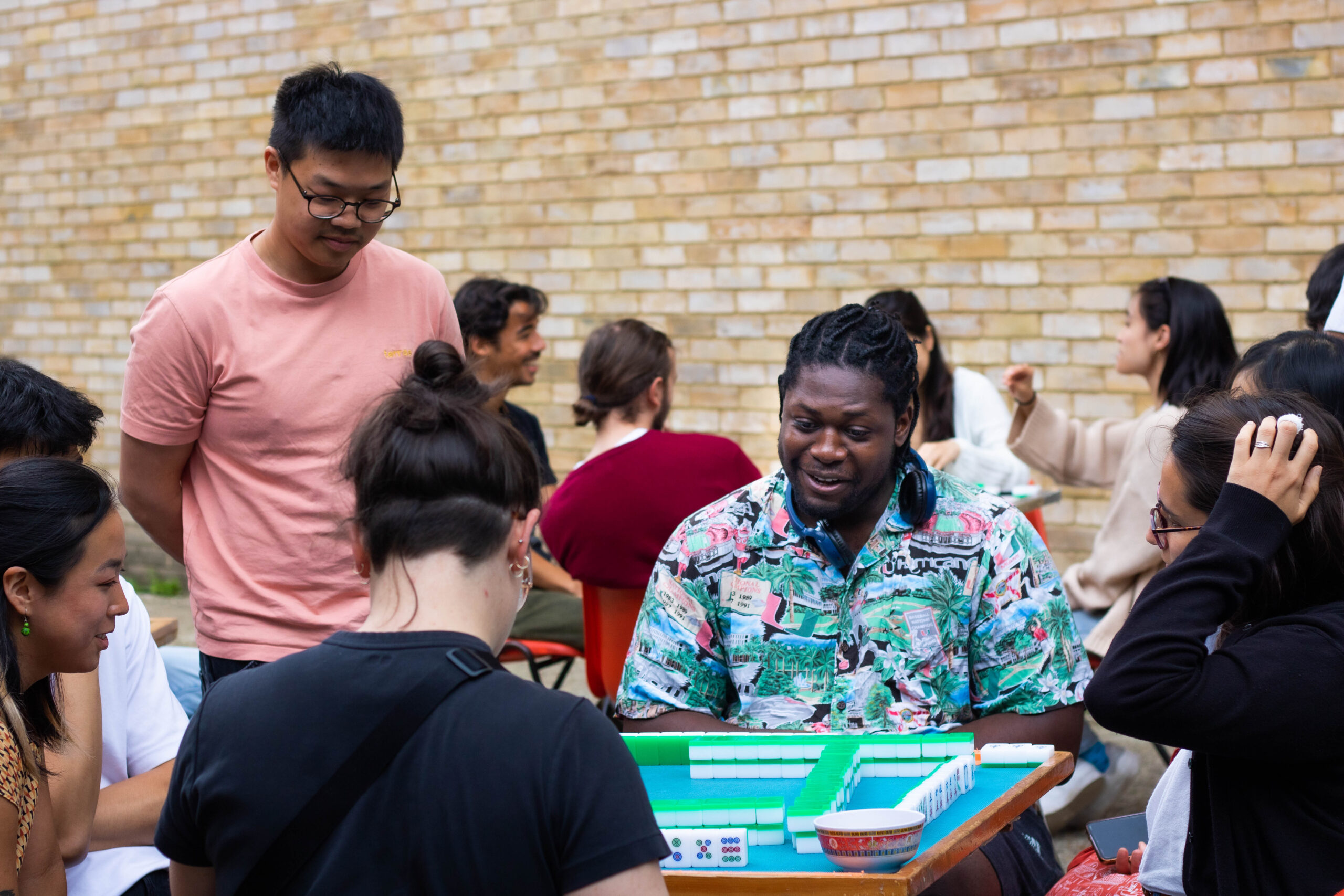
It’s 10am on a Saturday and the community centre is packed with young people. Square green tables dot the room, and waves of hands push the game tiles, creating a sound like pebbles on a beach rattling underwater. People are laughing, catching up, sipping on cups (and, when there’s a shortage, bowls) of tea poured by the centre’s caretaker. Occasionally, there are shrieks of delight and despair after someone flips their set of tiles to reveal a win, calls for a tutor to come over and help tally up the points or resolve a dispute.
Every Saturday morning, at least thirty young Londoners willingly drag themselves out of bed after a long workweek (or Friday night out) to gather in the Hackney Chinese Community Services (HCCS) to play mahjong for two hours, three if Michael the caretaker has the time.
Mahjong is a tile-based game originating from 19th century China. It’s intensely hard to describe this game in a written format, particularly if you haven’t seen it before, so I will decline to explain further, but readers are very welcome to come to the centre and learn.
For many of Chinese heritage and/or those who have watched the movie ‘Crazy Rich Asians’, we know the game but never played or learnt it. Mahjong is typically played by the older generation – there are mahjong clubs throughout the week at HCCS, mostly populated by the aunties and uncles who play significantly better and faster than us. Children are typically banned from playing due to mahjong’s stigma as a gambling game. My parents have forbidden me from even standing close to a mahjong table or looking at the tiles. Readers of this article are forbidden from sending this article to my parents.
Many of us have been left standing longingly on the outskirts of the room, listening to the clatter, wishing to understand the in-jokes that erupt when a certain tile is revealed, to weigh in on debates about strategy, to put their hands in and shuffle as well.
The founders of Four Winds Mahjong, the group that hosts the Saturday mahjong club, had less strict parents and were able to learn the game in their childhood. Chan Lap Fung (Chan is the last name, he goes by Fung) has been playing mahjong with his family for as long as he can remember. Monica Kam picked up the game from watching her family play. Isabel Wharton would play with her grandparents to connect with them despite the language barrier. And Connor Wan would routinely lose his Christmas pocket money to his parents.

Back in early 2021, Fung and Monica were volunteering at HCCS and chatting to Vicky Sung, the now-former ESEA Outreach Officer. They came across the topic of mahjong, and Vicky asked if they would be willing to teach the game. In August 2021, they began a test run of four sessions. All sessions quickly filled up, and regular Saturday sessions began.
HCCS was founded in 1985 and is located a short walk from London Fields overground. It’s a charity that serves the local East and South-East Asian (ESEA) community, predominately Chinese and Vietnamese people who are living nearby. When the local community organisation An Viet Foundation folded in 2017, HCCS expanded to include and continue services for the Vietnamese community. A wide range of activities and services are available at HCCS: helping and advising people with their benefits and pensions, ensuring residents are aware of their rights, providing luncheon clubs, karaoke, chess, table tennis, tai chi, lion dance classes and more. The space is also available for hire, and events such as supper clubs and book launches have been hosted here.
On the weekdays, predominately Chinese and Vietnamese people, and increasingly more European people recently, attend the lunch clubs and often join the centre for its other benefits. There’s a wide range of ages, mostly pensioners and babies in arms.
Events such as Four Winds Mahjong bring in large numbers of young people, to the extent that the caretaker is in the process of building more tables (mahjong ideally needs square tables with raised edges to keep the tiles from falling onto the floor). It’s a mix of people from different careers and walks of life, predominately those from ESEA heritage, but all are welcome.

For most of us, attending these sessions was the first time we had ever been in a room full of fellow ESEA people, especially people our age. Many of us grew up in predominately white neighbourhoods across the country. We have endured racism throughout our lives, particularly during 2020 due to COVID-related racism, which saw a 300% increase in reported hate crimes against ESEA people in the first few months of the year.
Having a space where ESEA people can gather in large groups, laugh loudly and experience joy without being stared at or receiving hostility has been deeply healing. It’s allowed us to realise what community actually means, what it feels like and to build our own. Many friendships have been made, and the mahjong club has been a central spot for ESEA movements to begin and gain momentum. Green Lions (a group focused on climate change) emerged from the club, and Baesianz FC members (a football team for Asian women and non-binary people) frequently attend, attracting more players and supporters to their games.
People with similar interests will branch off to watch movies and concerts together, visit cafes and restaurants, form swimming groups and more. Some return to the centre on other days to take part in other activities, the lunch clubs or book the space for their own events. Attendees have taken their newfound knowledge home and play with their families. One attendee doesn’t speak much Cantonese, and her grandmother doesn’t speak English but was recently able to reconnect by playing mahjong.
Saturday session players are encouraged to donate to the centre, and local restaurant My Neighbours The Dumplings hosts monthly mahjong nights with Four Winds Mahjong. There, attendees can play and order food and drinks with proceeds donated to HCCS.
The weekly sessions are regular fundraising events for HCCS, which relies on donations to keep its doors open and to serve the elderly ESEA people in the local area. Found Winds has also been supporting other community centres – recently, there was a themed event for Centre 151, which supports Vietnamese, Lao and Cambodian communities. The night was called ‘In the Mood For Mahjong’, referencing Hong Kong filmmaker Wong Kar-Wai’s movie, an event which came with catering, raffle and, of course, mahjong, raising just under £1,000 for the centre.
Sociologist Ray Oldenburg coined the term “third place”, meaning a space aside from home and work where people can build communities, socialise and simply live. Third spaces can include youth centres, parks, pubs, libraries, religious centres, gyms, allotments and of course, community centres.
Increasingly, our third places are now digital, taking the form of social media platforms. Our home and work spaces are becoming one, meaning we don’t even have a second space. Third spaces are becoming inaccessible due to the decline of funding for public spaces and private spaces’s costs of entry. Private spaces must operate on the model of chasing out customers after they have used the service to maximise profits, e.g. going to a cafe, having to purchase something to sit in the cafe and then having to leave once the purchase has been consumed.

Increasing levels of loneliness in cities are being reported across the world. It’s difficult to find space to just exist without having to make a financial transaction, to simply socialise with friends and build new relationships. How many of us have found it hard to make new friends as an adult outside of work? It’s especially hard when many public and private spaces are not safe or welcoming for people of colour, particularly women of colour. The last time I was in a pub, I had a stranger, unprovoked, repeatedly tell me “I’m going to f- kill you” until the pub owner threw him out. I have been in or had to help people in situations where they were stalked in a park, up-skirted or had their photos taken without consent.
Where are the places that people can regularly come to, regardless of income, without demanding anything of them, that are safe and allow space for joy? It’s not a business model that makes a profit, but it’s a model that creates a domino effect of good and creates momentum for other projects, businesses, collaborations, partnerships, fundraisers, etc. Also, it simply makes people happy, and aren’t we allowed that?
These few spaces left must be protected – developers have shown interest buying HCCS’s land and demolishing the centre to turn into flats, but due to laws preventing it, they lost interest.
Fung says, “If you give people, especially young people, the space to do something that they really want to do, then fantastic communities will come out of that”.
That’s all it takes. A space that allows people to come together, care about each other and have something fun to do.
Currently, Four Winds Mahjong is run by volunteers, and most do not come from leadership backgrounds. Fung is a train operator on the District Line, Monica is a lawyer, Isabel is a university lecturer, and Connor is a freelance creative and recent community organiser.
They’re supported by a team of volunteer tutors to help teach beginners. However, maintaining, organising, growing, planning, collaborating, teaching, and having lives outside of the club is hard work.
The team have had offers for private work and sessions but want to focus on community work. They have dreams of setting up two big themed charity events each year and a merchandise line of t-shirts, tote bags and even a Four Winds mahjong set. HCCS are trying to move into a bigger space, which will be welcomed as Four Winds are at capacity each week.
Imagine what could happen if communities like these were given support from organisations or programmes in the form of free training to leaders, funding to create larger events or to compensate the volunteers for their time and labour, and recognition for their efforts?
What often brought members to the centre was HCCS’s active Instagram presence. Helping spaces to improve and maintain their online and social media presence will in turn help them be used to their full potential by people of all ages.
Four Winds Mahjong Club has regularly brought a new generation of people into the community centre, helping us recognise the value of spaces like this and encouraging us to protect them. The club demonstrates how community action and solidarity can be rooted in joy and the simple love of a game. A young people’s mahjong renaissance is beginning in a little centre in Hackney.